What Is a Shopify Returns API? Complete Guide for Developers & Shopify Stores
API Integration
Returns have become one of the biggest factors influencing customer satisfaction in ecommerce. While fast shipping and competitive pricing help attract customers, the return experience often determines whether they'll shop with your store again.
For Shopify merchants, meeting these expectations isn't always easy. As order volumes grow, managing returns manually becomes time-consuming, increases operational costs, and creates unnecessary pressure on support teams.
This is where a Shopify Returns API becomes valuable.
A Shopify Returns API enables developers to build secure, automated return and exchange experiences directly into Shopify stores, mobile apps, or customer portals. Instead of relying on manual workflows, customers can initiate returns, upload proof images, request exchanges, update delivery information when eligible, and manage their return journey from a single interface.
The Indian Logistics Services (ILS) Return-Request API is designed specifically for this purpose. It provides a secure set of API endpoints that support return requests, exchanges, customer self-service actions, pickup management, authentication, standardized JSON responses, and mobile application integration.
Whether you're a Shopify developer creating a custom mobile application or a merchant looking to automate post-purchase operations, understanding how a Returns API works will help you deliver a faster, more reliable customer experience.
What Is a Shopify Returns API?
A Shopify Returns API is a set of endpoints that allows developers to build return and exchange functionality into custom applications, websites, mobile apps, or customer portals.
Instead of asking customers to contact support every time they want to return a product, the API enables the entire process to happen automatically.
Depending on the implementation, customers can:
- View eligible orders
- Check return eligibility
- Request a return
- Exchange products or variants
- Select refund methods
- Upload proof images
- Add notes for the merchant
- Track return status
- Reschedule pickup requests
- Receive status updates
For merchants, this creates a much more efficient return management process. For developers, it eliminates the need to build complex return workflows from scratch.
Unlike traditional return forms, a Returns API creates a structured communication layer between Shopify, customer-facing applications, and return management systems.
Shopify Returns API vs Manual Return Management
| Manual Return Process | Shopify Returns API |
|---|---|
| Customers email support | Customers submit returns themselves |
| Support verifies every request manually | Eligibility is checked automatically |
| Refunds and exchanges handled separately | Unified return workflow |
| Manual communication | Automated status updates |
| Multiple spreadsheets and systems | Centralized return management |
| Slower processing | Faster and more consistent experience |
As customer expectations continue to evolve, self-service returns are becoming a standard feature rather than a competitive advantage.
Why Returns Have Become Critical for Shopify Stores
Returns are often viewed as a cost of doing business. In reality, they're an opportunity to build trust and encourage repeat purchases.
A positive return experience can lead to:
- Higher customer satisfaction
- Better online reviews
- Increased repeat purchases
- Greater brand loyalty
- Lower support workload
- Faster issue resolution
For growing Shopify businesses, investing in return automation is no longer optional, it's an important part of delivering a modern ecommerce experience.
Why Manual Return Processes Stop Scaling
Many Shopify stores begin with simple return workflows:
- Customer email support.
- Support checks the order manually.
- The team verifies eligibility.
- Refunds or exchanges are processed manually.
- Customers wait for updates.
This process may work when handling only a handful of orders each week.
However, as order volume grows, manual workflows quickly create operational challenges.
Common Problems
- Delayed response times
- Duplicate customer inquiries
- Manual eligibility checks
- Human errors
- Difficult exchange management
- Limited return tracking
- Increased support costs
- Poor customer experience
These issues don't just affect internal operations, they also influence customer retention.
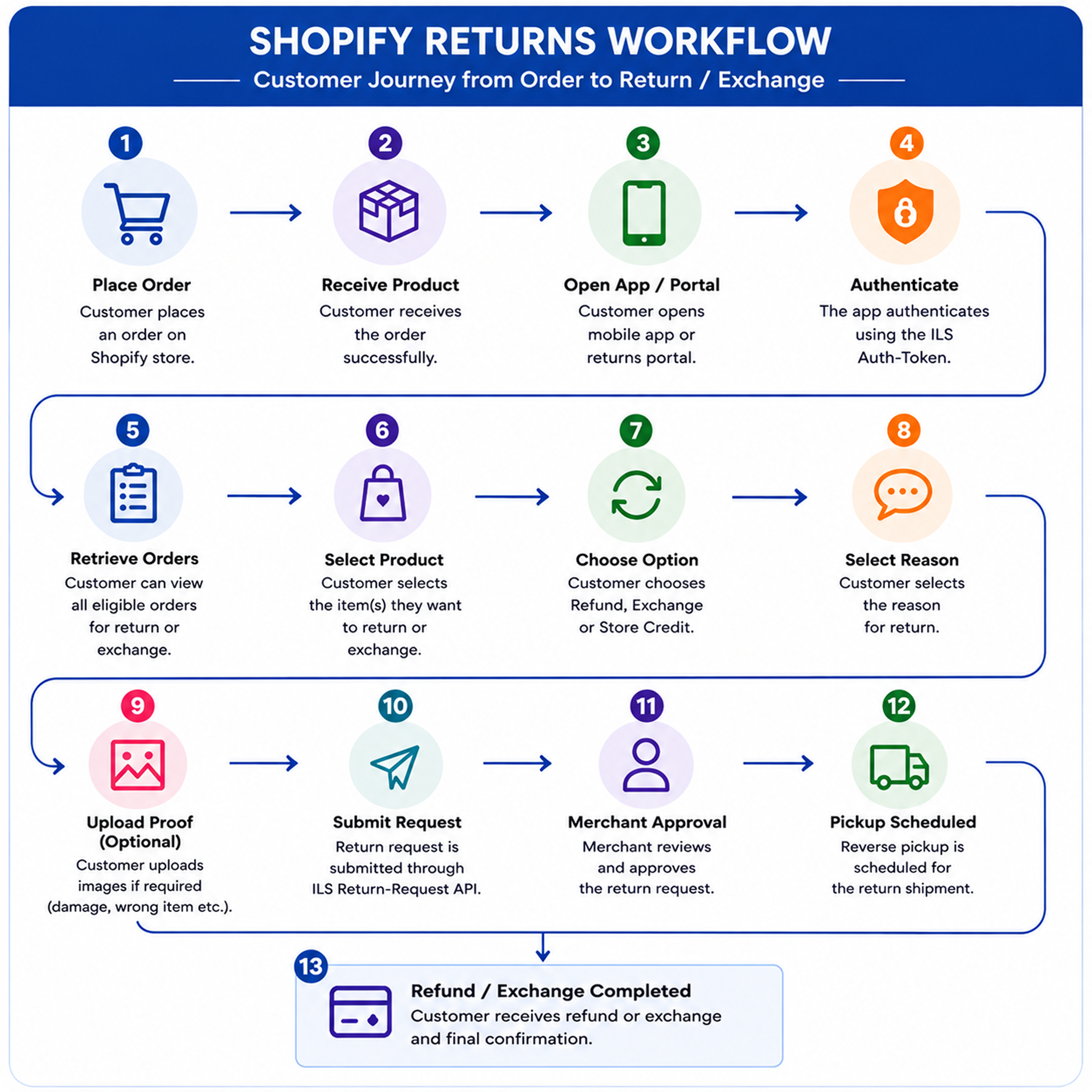
Typical Shopify Returns Workflow
A modern Shopify Returns API usually follows this workflow.
This structured workflow reduces manual effort while providing customers with a more transparent experience.
Features Every Shopify Returns API Should Have
Not every Shopify Returns API offers the same capabilities. Some solutions only allow customers to submit return requests, while others provide a complete post-purchase experience that includes exchanges, pickup management, order modifications, and customer self-service.
1. Secure Authentication
Every API should start with security.
Since return requests involve customer information, shipping addresses, order details, and refund preferences, every request should be authenticated before any data is returned.
The Indian Logistics Services (ILS) Return-Request API uses a long-lived Auth-Token that's unique to each Shopify store. Every request is verified to ensure:
- The ILS app is installed
- The merchant has an active plan
- The Return Request feature is enabled
- The authentication token matches the registered Shopify store
2. Merchant-Specific Return Settings
Every Shopify business has a different return policy.
The ILS Return-Request API includes a dedicated endpoint for loading merchant-specific return settings, such as:
- Return reasons
- Refund methods
- Exchange options
- Store credit availability
- Theme colors
- Return page headings
- Customer notes
- Proof image settings
- Partial return support
- Custom button labels
3. Customer Order Lookup
Customers shouldn't need to contact support just to locate an order.
A good Returns API lets them quickly retrieve eligible orders using their order details.
The ILS API allows applications to fetch recent customer orders, helping users:
- Find eligible purchases
- View order summaries
- Check fulfillment status
- Continue the return process with minimal effort
Providing self-service order lookup reduces support requests while improving the overall customer experience.
4. Returns, Exchanges, and Store Credit
Today's customers expect more than just refunds.
Many shoppers prefer:
- Product exchanges
- Different variants
- Store credit
- Alternative products
Supporting multiple resolution options gives customers greater flexibility while helping merchants retain revenue.
5. Pickup Scheduling and Rescheduling
Reverse logistics doesn't end after a return request is submitted.
Customers often need visibility into pickup status, and in some cases, they may need to reschedule a missed or declined pickup.
A modern Returns API should support pickup management to avoid unnecessary support requests and improve operational efficiency.
The ILS Return-Request API includes pickup rescheduling functionality as part of its return workflow.
Developer Benefits at a Glance
| Without a Returns API | With a Returns API |
|---|---|
| Build every workflow manually | Integrate ready-made endpoints |
| Custom validation logic | Standardized eligibility checks |
| Separate systems for returns | Unified return workflow |
| More maintenance | Easier updates |
| Longer development cycles | Faster implementation |
| Higher risk of errors | Consistent API responses |
For teams building Shopify mobile apps, customer portals, or custom storefronts, this approach saves development time while improving reliability.
Introducing the Indian Logistics Services (ILS) Return-Request API
Building a return management system involves much more than simply creating a "Return" button.
Developers need to validate customers, retrieve eligible orders, check return windows, manage exchanges, schedule reverse pickups, and ensure every request is secure. Building these capabilities from scratch takes considerable development effort and ongoing maintenance.
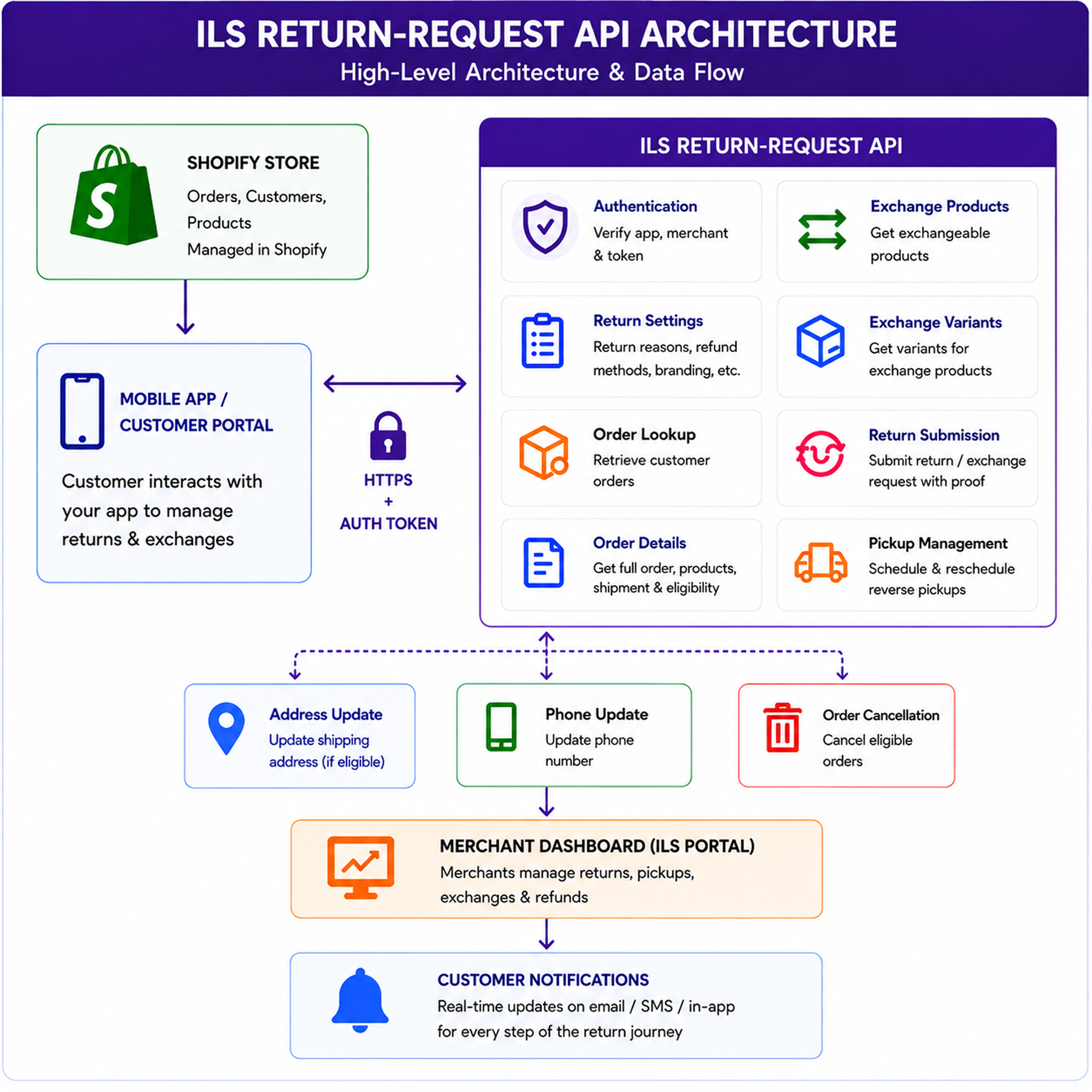
The Indian Logistics Services (ILS) Return-Request API simplifies this process by providing a unified API for return management within the Shopify ecosystem.
Instead of integrating multiple independent services, developers can access a complete set of endpoints that support the customer return journey—from retrieving return settings to submitting return requests and managing exchanges.
What the ILS Return-Request API Can Do
According to the documentation, the API enables developers to:
- Load merchant-specific return settings
- Authenticate requests securely
- Retrieve customer order lists
- View complete order information
- Update customer shipping addresses (when eligible)
- Update customer phone numbers
- Cancel eligible orders
- Submit return requests
- Request product exchanges
- Retrieve exchange variants
- Upload proof images
- Reschedule reverse pickups
- Receive standardized JSON responses
- Integrate seamlessly with mobile applications
Rather than acting as a single-purpose API, it provides the building blocks for a complete post-purchase experience.
Why ILS Portal Complements Your Shopify Returns Workflow
A Returns API is only one part of an efficient post-purchase experience.
Businesses also need visibility into orders, shipments, customer actions, and reverse logistics. That's where ILS Portal adds value.
ILS Portal works alongside the Return-Request API by helping merchants manage returns and customer requests from a centralized platform.
Together, they help businesses:
- Automate customer return requests
- Reduce manual intervention
- Manage exchanges efficiently
- Improve reverse logistics visibility
- Support Shopify mobile applications
- Deliver a consistent post-purchase experience
For growing Shopify stores, having return management and logistics workflows connected in one ecosystem helps simplify operations while improving customer satisfaction.
Final Thoughts
Returns are no longer just an operational necessity, they're a key part of delivering an exceptional customer experience. As Shopify businesses grow, manual return processes become harder to manage, leading to slower response times, increased support costs, and frustrated customers.
A well-designed Shopify Returns API helps solve these challenges by automating return requests, exchanges, customer updates, and reverse logistics. For developers, it provides a structured foundation for building reliable post-purchase experiences. For merchants, it creates a more efficient workflow that saves time while improving customer satisfaction.
The Indian Logistics Services (ILS) Return-Request API extends these benefits by offering a comprehensive set of capabilities, from authentication and order lookup to exchanges, proof image uploads, and pickup management, all within a consistent API framework. Combined with Indian Logistics Services Shopify App, it enables Shopify businesses to streamline returns and build scalable customer experiences without the complexity of managing multiple disconnected systems.
Frequently Asked Questions
What is a Shopify Returns API?
A Shopify Returns API allows developers to integrate return and exchange functionality into Shopify stores, websites, customer portals, or mobile applications, enabling customers to manage returns through a structured workflow.
Who should use a Shopify Returns API?
It's ideal for Shopify developers, agencies, enterprise businesses, and merchants looking to automate return management and improve the post-purchase experience.
What are the benefits of using a Returns API?
Some of the biggest advantages include:
- Faster return processing
- Reduced support workload
- Better customer experience
- Automated workflows
- Easier integration with mobile applications
- Improved operational efficiency
Can customers exchange products using the ILS Return-Request API?
Yes. The API supports exchanges by allowing applications to retrieve exchange products and variants, making it easier for customers to request replacements instead of only refunds.
Can customers update their shipping address after placing an order?
When eligible, the API provides functionality for updating shipping addresses before fulfillment, reducing the need for manual support intervention.
Does the API support pickup rescheduling?
Yes. The documentation includes functionality for rescheduling declined or cancelled reverse pickups as part of the return workflow.
Is the ILS Return-Request API suitable for Shopify mobile apps?
Yes. The API is designed to support mobile application integration and uses secure authentication with standardized JSON responses, making it suitable for custom Shopify mobile experiences.
How is the ILS Return-Request API secured?
Each request requires an Auth-Token, and the server validates the app installation, merchant plan, feature availability, and token before processing requests.