10-Min vs 1-Day Delivery: Cost, Logistics & Courier Comparison for Indian Businesses
Last-Mile Delivery
Delivery speed is no longer just an operational decision, it's a business strategy. For Indian ecommerce store owners, the promise you make on delivery timelines directly affects conversion rate, cart abandonment, customer trust, and repeat purchases.
While "10-minute delivery" often grabs headlines, most ecommerce brands actually scale on one day delivery using reliable courier networks.
So the real question for ecommerce business owners is:
Which delivery model helps you grow profitably without over-complicating logistics?
This blog breaks down 10-minute delivery vs 1-day delivery purely from an ecommerce business and logistics operations perspective, helping you choose the right shipping model for your online store.
A reliable one day delivery app helps ecommerce businesses manage faster order fulfillment, coordinate with courier partners, and provide accurate delivery timelines to customers.
Why Delivery Speed Matters for Ecommerce Stores
For ecommerce store owners, delivery speed impacts:
- Purchase decisions on product pages
- Trust during checkout
- Brand perception post-order
- Return rates & customer support load
However, faster is not always better if it increases cost, operational risk, or complexity.
What Is 10-Minute Delivery?
10-minute delivery is a hyperlocal fulfilment model that relies on:
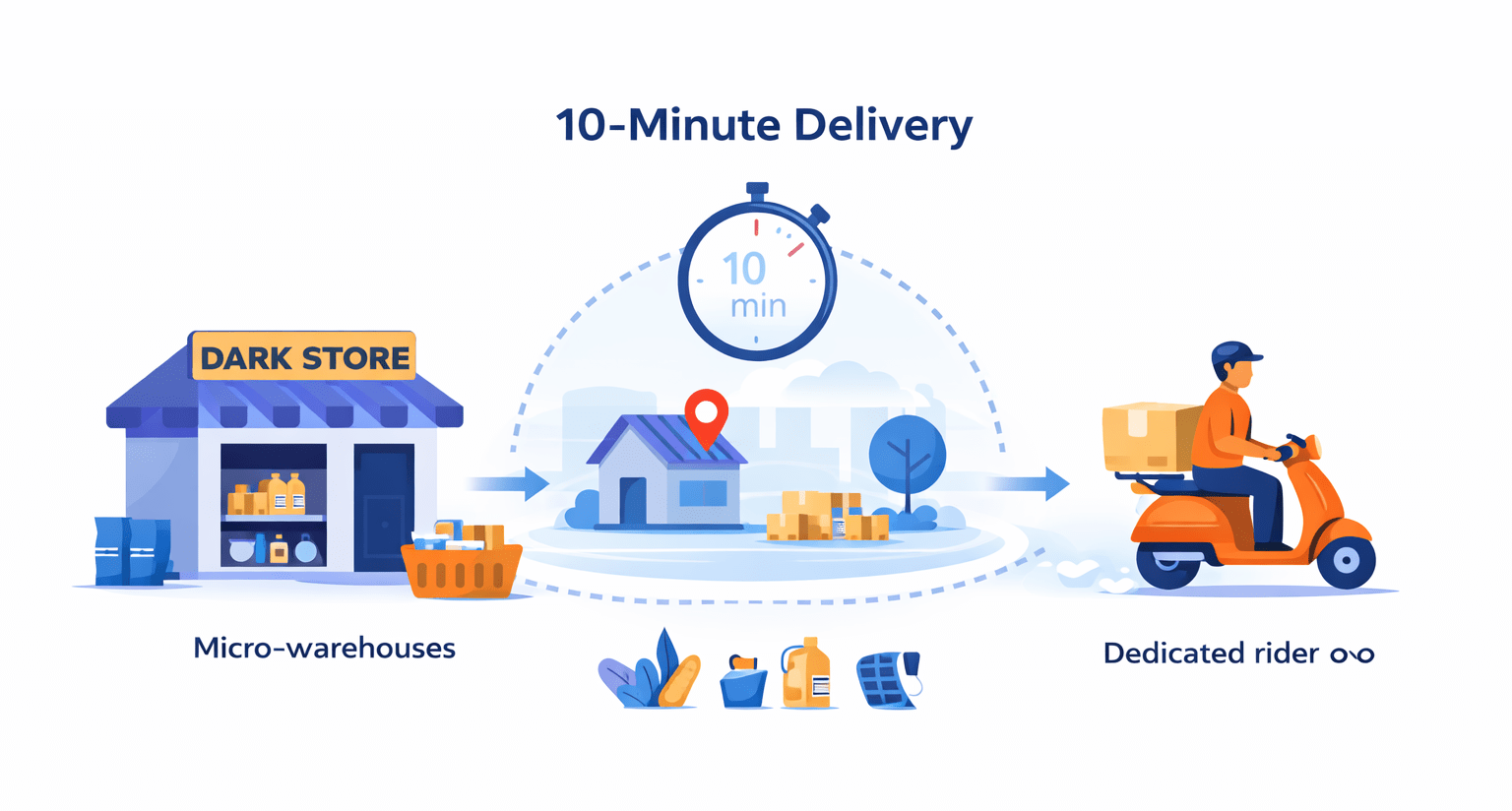
- Micro-warehouses or dark stores
- Inventory is placed extremely close to buyers
- Dedicated rider fleets
- Limited SKUs with high turnover
This model is not designed for typical ecommerce stores that:
- Sell across cities or states
- Offer multiple product categories
- Depend on courier partners
- Operate on optimised margins
10-Min Delivery (Quick Commerce)
Pros: Extremely fast fulfilment improves instant gratification and works well for urgent, low-value purchases within limited service areas.
Cons: High operational costs, limited product range, heavy inventory duplication, and poor scalability make this model unsustainable for most ecommerce businesses.
Best For: Hyperlocal sellers, grocery and essentials brands, or single-city businesses with high order frequency and strong funding support.
What Is 1-Day Delivery for Ecommerce Stores?
One day delivery app (next-day delivery) is the most widely used model in Indian ecommerce.

It works through:
- Central or multi-warehouse inventory
- Courier partners with regional hubs
- Automated order processing
- Real-time tracking and notifications
This model allows ecommerce businesses to:
- Ship PAN India
- Control shipping costs
- Scale without heavy infrastructure
Platforms like ILS Portal exist specifically to simplify and automate this delivery model.
1-Day Delivery (Same/Next-Day Delivery)
Pros: Cost-efficient, scalable, and supported by established courier networks, making it ideal for PAN-India ecommerce operations with predictable delivery performance.
Cons: Slightly slower than instant delivery and dependent on courier reliability, which requires proper courier selection and tracking management.
Best For: D2C brands, ecommerce stores, marketplace sellers, and businesses shipping multiple product categories across cities and states.
Key Considerations When Choosing a Delivery Model
Urgency: If your products are not time-critical, customers usually prefer reliable next-day delivery over instant but inconsistent fulfilment.
Product: High-value, non-perishable, or fashion and lifestyle products are better suited for 1-day delivery rather than hyperlocal instant shipping.
Cost: Sustainable ecommerce growth depends on controlled shipping costs; 1-day delivery provides better margins and pricing flexibility.
Ethics: Quick commerce often relies on delivery partners under extreme time pressure, while 1-day delivery allows more responsible, scalable, and ethical logistics operations.
E-commerce-Focused Comparison: 10-Min vs 1-Day Delivery
| Factor | 10-Minute Delivery | 1-Day Delivery |
|---|---|---|
| Delivery Type | Hyperlocal | Regional / National |
| Coverage | Limited (specific cities & zones) | PAN India |
| Fulfillment | Dark stores | Warehouses + couriers |
| Cost per order | Very high | Optimized |
| Scalability | Limited | Highly scalable |
| Courier dependency | Minimal | High |
| Technology reliance | Extreme | Moderate |
| Profit margins | Thin / negative | Sustainable |
Cost Impact for Ecommerce Businesses
Delivery speed directly affects ecommerce margins. Faster models increase fulfilment, inventory, and operational costs, while optimised delivery timelines help store owners maintain profitability, predictable expenses, and healthier unit economics as order volumes grow.
Cost Reality of 10-Minute Delivery
For ecommerce sellers, implementing 10-minute delivery would require:
- Renting multiple micro-warehouses
- Maintaining duplicate inventory
- Hiring delivery riders
- Managing real-time stock accuracy
This significantly increases:
- Per-order fulfilment cost
- Inventory risk
- Operational overhead
Result: Not sustainable for most ecommerce stores.
Cost Efficiency of 1-Day Delivery
1-day delivery uses established courier networks and centralised warehouses, allowing ecommerce businesses to reduce per-order shipping costs, optimise zone-based pricing, and scale operations without investing in expensive hyperlocal infrastructure.
1-day delivery enables ecommerce businesses to:
- Use existing courier infrastructure
- Ship in bulk
- Negotiate courier rates
- Optimise zone-based pricing
With the ILS Portal, ecommerce owners can:
- Compare courier rates
- Auto-assign AWBs
- Generate shipping labels and GST invoices
- Process orders in bulk
This keeps shipping costs predictable and manageable.
Courier Strategy: A Core Advantage of 1-Day Delivery
Ecommerce brands relying on 1-day delivery gain flexibility by choosing couriers based on speed, cost, and serviceability, enabling better delivery performance across metro, tier-2, and tier-3 cities.
Challenges Without a Courier Aggregation App
- Manually managing multiple courier dashboards
- No performance comparison
- Delays in AWB generation
- Tracking is scattered across platforms
How ILS Portal Solves This
ILS Portal brings multiple courier partners integration into a single dashboard, enabling ecommerce store owners to generate AWBs, manage pickups, track shipments in real time, and optimise courier selection without switching between platforms.
- Ship using Delhivery, Blue Dart, DTDC, Ecom Express, Ekart, Amazon Shipping, Smartr, XpressBees, and more
- Generate AWBs and labels instantly
- Schedule pickups
- Track shipments in real time
- Send automated email notifications
With proper AWB trackon, ecommerce store owners can monitor shipment status in real time, reduce delivery-related queries, and ensure a transparent post-order experience for customers.
This level of control is essential for scaling ecommerce operations.
Customer Experience: What Ecommerce Buyers Actually Expect
Ecommerce buyers prioritise reliable delivery timelines, accurate tracking, proactive updates, and secure packaging. Consistent communication matters more than extreme speed, helping brands build trust and reduce support queries.
Contrary to popular belief, ecommerce buyers value:
- Reliable delivery timelines
- Accurate tracking
- Clear communication
- Damage-free packaging
Most customers are comfortable waiting 1 day if they:
- Trust your brand
- Receive tracking updates
- Are informed about shipment status
ILS Portal enhances this experience with:
- Live order tracking
- Automated email notifications
- Order status synchronisation
Scalability: The Deciding Factor for Ecommerce Growth
| Aspect | 10-Min Delivery | 1-Day Delivery |
|---|---|---|
| City expansion | Very expensive | Cost-efficient |
| New product categories | Limited | Flexible |
| Seller onboarding | Complex | Simple |
| Technology dependency | Extreme | Balanced |
| Long-term viability | Risky | Proven |
ILS Portal further supports scalability with:
- Multi-warehouse management
- Staff roles & permissions
- Bulk order processing
- Analytics & performance views
Which Ecommerce Businesses Should Choose Which Model?
Hyperlocal sellers with limited SKUs may explore instant delivery, but most ecommerce stores, especially D2C and PAN-India brands, benefit from 1-day delivery due to better cost control, scalability, and logistics reliability.
Also Read: https://ilsportal.io/blogs/ecommerce-delivery-partners
10-Minute Delivery (Rare Ecommerce Use Case)
- Hyperlocal niche sellers
- Single-city operations
- Limited SKUs
1-Day Delivery (Best Fit for Most Stores)
- Shopify & WooCommerce stores
- D2C brands
- Marketplace sellers
- B2B ecommerce businesses
- PAN India shipping operations
Why ILS Portal Is Built for 1-Day Ecommerce Shipping
ILS Portal is designed for ecommerce businesses that ship daily at scale, offering multi-courier access, bulk order processing, GST-compliant invoices, return management, and analytics to support efficient and scalable 1-day delivery operations.
With ILS Portal, you can:
- Manage multiple couriers in one app
- Process bulk ecommerce orders
- Generate GST-compliant invoices
- Track shipments in real time
- Manage returns and notifications
- Analyse shipping performance
All without juggling multiple tools.
Final Thoughts
While ultra-fast delivery models attract attention, long-term ecommerce success depends on reliability, cost efficiency, and operational control. For most online stores, 1-day delivery offers the ideal balance between customer expectations and sustainable growth.
By leveraging a centralised logistics app like Indian Logistics Services, ecommerce store owners can simplify shipping, optimise courier performance, reduce costs, and scale their business across India with confidence and consistency.
Frequently Asked Questions
1. Is 10-minute delivery practical for ecommerce stores?
No. It requires heavy infrastructure and is not scalable for typical ecommerce models.
2. Can ecommerce stores offer 1-day delivery across India?
Yes. With courier partners and platforms like ILS Portal, PAN India 1-day delivery is achievable.
3. Does faster delivery improve ecommerce conversions?
Reliable delivery improves conversions more than ultra-fast delivery.
4. How does ILS Portal help ecommerce store owners?
ILS Portal centralises shipping, couriers, tracking, returns, invoices, and analytics in one app.
5. Can I manage multiple warehouses using the ILS Portal?
Yes. ILS Portal supports multi-warehouse shipping and staff permissions.